Skip to content

Receiving

Goods receipt software that counts what arrived before anything is owed.

The store records received, accepted and rejected quantities against the purchase order, line by line, at the dock. Partial deliveries stay open with their balance, rejected stock never becomes billable, and accepted goods reach stock straight away.

What is goods receipt software?

Goods receipt software records what a supplier actually delivered against the purchase order: how much arrived, how much was accepted and how much was rejected. That record, often called a goods received note or GRN, updates stock and becomes the receiving leg of the three-way match that decides what the invoice may charge.

How it works

Goods receiving, step by step.

  1. 01

    Open the PO at the dock

    When a delivery arrives, the store opens the purchase order it belongs to. The ordered lines and quantities are already there.

  2. 02

    Record what was received

    For each line, the receiver enters the quantity that arrived.

  3. 03

    Accept or reject per line

    Each line is split into accepted and rejected quantities. Damaged, wrong or out-of-spec goods are rejected on the line they came in on.

  4. 04

    Stock updates on acceptance

    Accepted quantities join that site's stock the moment they are recorded. Rejected quantities never do.

  5. 05

    The balance stays open

    If the delivery was short, the PO keeps the outstanding balance open for the next delivery.

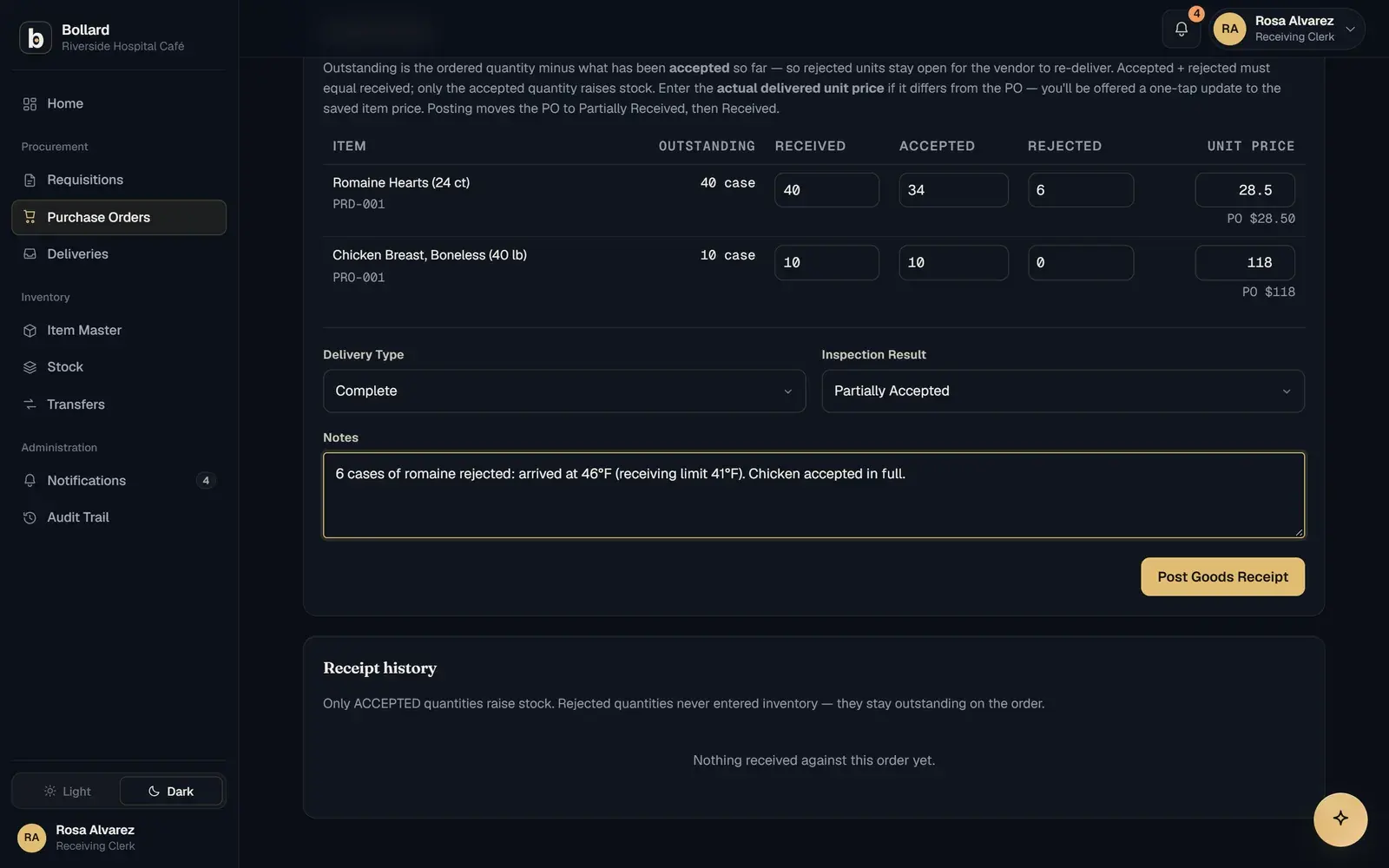
A goods receipt form with ordered, received, accepted and rejected quantities for each line.

What does goods receipt software record?

Goods receipt software records the delivery against the purchase order it fulfils, and in Bollard that record holds three numbers on each line: received, accepted and rejected. Together they make the goods received note that stock and invoice matching rely on.

The gap between received and accepted is the important one. A pallet can arrive complete and still contain a damaged case. If only the received quantity is recorded, the damaged case gets counted, stocked and paid for. Recording acceptance separately means the organisation owes only for what it agreed to keep.

How does Bollard handle partial deliveries?

A partial delivery is received for the quantities that came, and the purchase order keeps the balance open for the rest. The store can receive the remainder against the same PO when it arrives.

Short shipments are a frequent reason an invoice fails a match, because a supplier may invoice the full order after delivering part of it. Closing a PO on a short shipment hides what the supplier still owes. Keeping the balance open keeps the gap visible, and the invoice is matched against what has been accepted so far.

What happens to rejected goods?

Rejected quantities are recorded on the line they arrived on, and they never become billable. When the invoice comes in, the three-way match uses accepted quantities only, so rejected stock is excluded automatically.

Nobody has to remember the damaged case when the invoice lands three weeks later. In the multi-unit dining configuration, this is how rejected perishables are kept off the invoice: a box of wilted romaine hearts turned away at the kitchen door stays off the bill.

What else can be recorded when goods are received?

Beyond quantities, receiving can capture the details a sector needs at the point of delivery. These are configurations of the same receiving screen, in the store's own terms, whether it is called a central pharmacy, an equipment yard or a central commissary.

  • Regional healthcare: lot number and expiry date recorded on receipt, supporting the organisation's own traceability work
  • Civil construction: bulk deliveries checked against weighbridge tickets
  • Multi-unit dining: contract prices held on every delivery, with rejected perishables kept off the invoice

How does receiving against a purchase order connect to invoice matching?

Receiving sits between the purchase order and the three-way match, and it supplies the quantities the match depends on.

The step before is the PO. The receiver works from the order's lines, so they record against what was agreed instead of a delivery docket alone.

The step after is the three-way match. The invoice is compared with the PO's prices and the receipt's accepted quantities, line by line. A short or rejected delivery shows up as a quantity failure on the invoice, and payment waits until the invoice agrees.

Why record receipts in software and not on a spreadsheet?

On a spreadsheet, keeping rejected goods off the bill relies on someone noticing, and in a typical ERP it depends on how receiving was set up. Bollard records rejects per line at the dock and the match excludes them automatically.

Spreadsheet receiving also leaves stock figures behind reality, because a count goes in when someone gets to it and anyone can overwrite a cell. Inventory accuracy is a known weak point: one study across 37 stores of a single retailer found 65% of inventory records were wrong (DeHoratius and Raman, Management Science, 2008). Updating stock at the moment of acceptance removes one common source of that gap.

Questions

Common questions.

What is the difference between a goods receipt and an invoice?

A goods receipt is the buyer's own record of what arrived and what was accepted. An invoice is the supplier's request for payment. The two are compared in a three-way match with the purchase order, and in Bollard payment can only be raised once the invoice agrees with the PO price and the accepted quantity.

Who records goods receipts?

Usually the store, or whoever takes delivery at the site: a storekeeper, a head chef, a site foreman or a lead nurse, depending on the organisation. Bollard is configured with your role names, and each site sees only its own deliveries, enforced with row-level security in the database.

Can you receive goods without a purchase order?

In Bollard, receipts are recorded against a purchase order, because the PO holds the price and quantities the receipt is checked against. A delivery with no order behind it usually means something was bought outside the process, and it is worth finding out why before the goods are accepted into stock.

When does stock update after a delivery?

The moment goods are accepted. Accepted quantities go straight into that site's live balance, and rejected quantities never enter stock. Reorder alerts and transfer decisions are then based on what is really on the shelf, and every stock increase ties back to a receipt line on a purchase order.

What is a partial delivery?

A partial delivery is a shipment that brings only part of what was ordered. Bollard records the quantities that arrived and keeps the rest of the purchase order open with its balance, so the remaining goods can be received later and the supplier is only paid for what has been accepted.

Does Bollard record lot numbers and expiry dates on receipt?

It can. In the configuration Safock offers for regional healthcare, lot number and expiry are recorded on receipt, which supports the organisation's own traceability work across clinics. Bollard is configured to each customer, so what the receiving screen captures is agreed for your sector during discovery.

See Bollard set up for your operation.

Tell us how you buy and store today. We'll walk you through Bollard configured with your sites, roles and approval rules.

Book a demo
support@safock.com